Third Party Tested by Freedom Diagnostics
Collagen Increase
vs 50% vitamin C, 40% retinoic acid
Genes Modulated
Hair Growth
Visible Results
Third Party Tested by Freedom Diagnostics
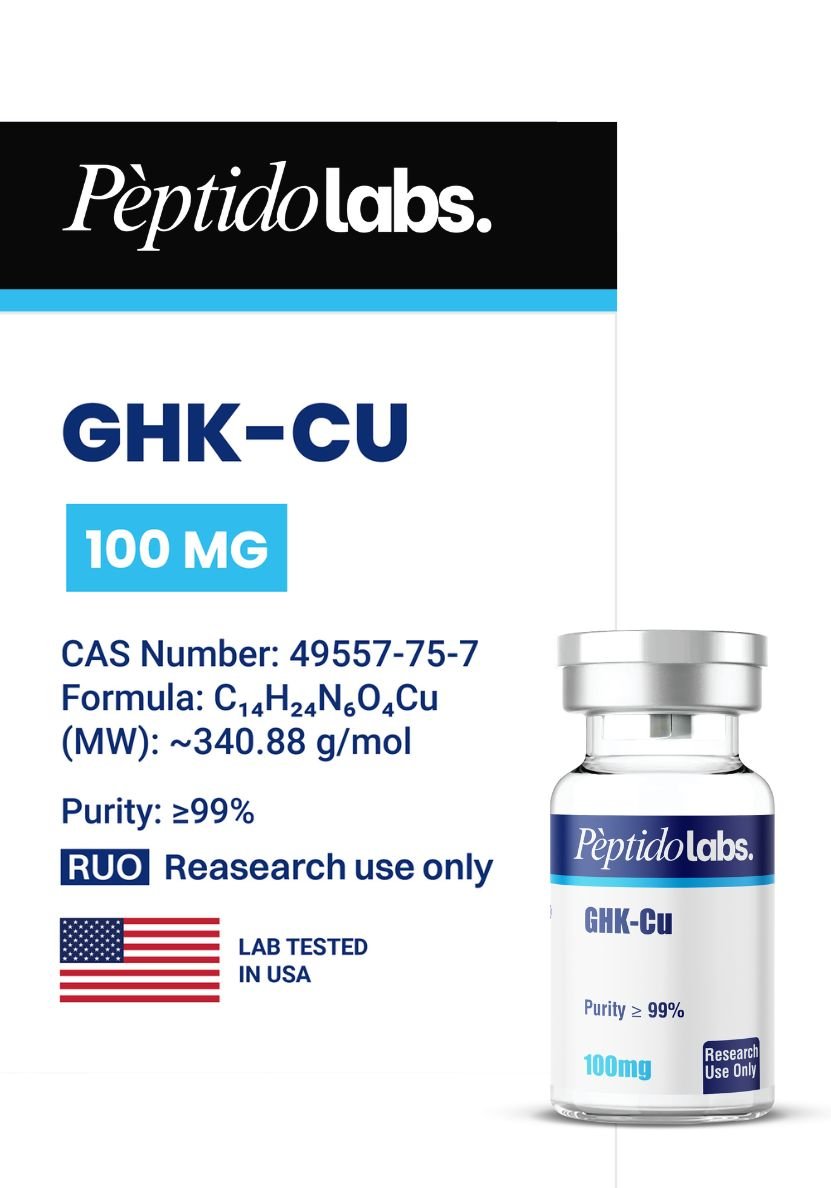
GHK-Cu is a naturally occurring tripeptide that binds with copper to create a powerful regenerative complex. Released from damaged collagen as an injury signal, it orchestrates healing by modulating thousands of genes involved in tissue repair, inflammation control, and cellular protection.
Upregulates 59% of affected genes activates 47 DNA repair genes suppresses inflammatory pathways
Stimulates type I & III collagen increases elastin production enhances ECM remodeling
Delivers copper to cells activates SOD antioxidant supports wound healing enzymes
GHK-Cu affects more human genes than any other studied peptide — modulating 31.2% of the human genome.
Summary of clinical and preclinical findings
Wrinkle Reduction Comparison
Objective measurements from clinical studies
Improved collagen production
vs 50% vitamin C
Wrinkle volume reduction
vs control serum
Wrinkle depth decrease
12-week measurement
Objective measurements from clinical studies
Natural GHK-Cu levels decrease significantly with age
-200 ng/mL
-140 ng/mL
-80 ng/mL
-40 ng/mL
Other benefits observed in research
Research shows GHK-Cu significantly improves hair growth parameters
Multiple pathways contribute to enhanced healing
GHK-Cu acts as a master regulator of cellular health
4,000+
Genes Affected
Multiple mechanisms combat oxidative stress
What clinical studies report
Copper toxicity is theoretically possible with extreme overuse but has not been reported in clinical studies.
Technical specifications
Protect from light.
Avoid repeated freeze-thaw.
Blue color indicates copper binding.
Lyophilized (powder)
-20°C • up to 2 years
Reconstituted
2-8°C • up to 30 days
Working solution
Use within 24 hours
Naturally Occurring.
Discovered 1973.
4000+ Publications
Common questions about GHK-Cu research
GHK-Cu is a naturally occurring tripeptide (glycyl-L-histidyl-L-lysine) that binds with copper. It was first discovered in human plasma in 1973 and is also found in saliva and urine. The peptide is released from tissues during injury as part of the body’s natural healing response. Levels decline significantly with age, dropping from about 200 ng/mL at age 20 to 80 ng/mL at age 60.
Clinical studies demonstrate significant benefits: A 12-week facial study on 67 women showed improved skin density, thickness, and reduced wrinkle depth. When applied to thigh skin, 70% of participants showed improved collagen production (compared to 50% with vitamin C and 40% with retinoic acid). Research also shows it modulates 31.2% of human genes, affecting over 4,000 genes involved in tissue repair, inflammation, and cellular health.
Research has explored multiple delivery methods. Topical application (2-4% concentration in creams/serums applied twice daily) is most common in clinical trials. Injectable forms (1-2mg subcutaneous) are used in specialized research. The peptide has a short plasma half-life of 30-60 minutes but effects persist 12-24 hours due to gene modulation. Studies typically run for 12 weeks to assess visible results.
GHK-Cu has demonstrated an excellent safety profile across all published studies. Side effects are minimal and mild, including temporary injection site irritation (5%), skin redness with topical use (3%), and mild itching (2%). No serious adverse events have been reported in clinical trials. The discontinuation rate is less than 1% for topical use. The only contraindications are Wilson’s disease and known copper allergies.
GHK-Cu shows superior collagen stimulation compared to standard treatments – 70% improvement versus 50% for vitamin C and 40% for retinoic acid. Unlike single-target compounds, it affects thousands of genes simultaneously. It’s also naturally occurring in the body, unlike synthetic alternatives, and has been safely used in cosmetics since the 1980s with over 50 published clinical studies supporting its efficacy.
Peer-reviewed research
International Journal of Molecular Sciences
Regenerative and Protective Actions of the GHK-Cu Peptide in the Light of the New Gene Data
2018 • PMID: 29986520
Pickart L, Margolina A
BioMed Research International
GHK Peptide as a Natural Modulator of Multiple Cellular Pathways in Skin Regeneration
2015 • PMID: 26236730
Pickart L, Vasquez-Soltero JM,...
Journal of Cosmetic Science
A 12-week, double-blind, placebo-controlled study of GHK-Cu facial cream
2005
Finkley et al.
Journal of Cosmetic Laser Therapy
Stimulation of collagen production by copper-peptide complex
2007
Appa Y et al.
Journal of Aging Science and Clinical Practice
Effects of GHK-Cu in nano-carriers on MMP expression and facial wrinkle parameters
2009
Gorouhi F, Maibach HI
Archives of Facial Plastic Surgery
Effects of Topical Copper Tripeptide Complex on CO2 Laser-Resurfaced Skin
2006 • DOI: 10.1001/archfaci.8.4.252
Miller TR et al.
Various Sources
GHK-Cu effects on hair follicle growth and size
2020
Multiple researchers
Multiple Sources
GHK-Cu dosing and administration protocols
2018
Various clinical trials
Journal of Cosmetic Dermatology
Anti-inflammatory effects of GHK-Cu
2012
Campbell JD et al.