Plasma Concentration Studies

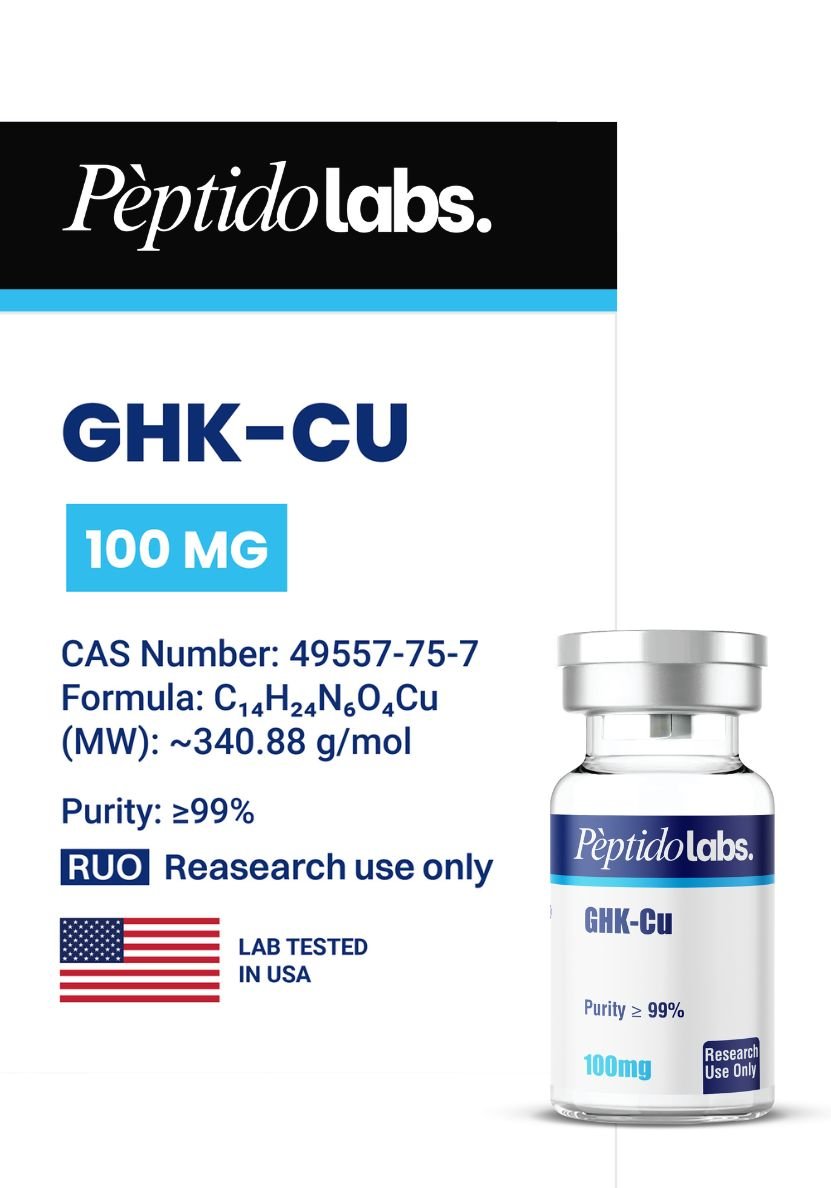
GHK-Cu

Copper Tripeptide-1

Glycyl-L-histidyl-L-lysine Copper C

A naturally occurring copper tripeptide that promotes tissue remodeling, wound healing, and collagen synthesis in animal and in vitro studies. Premium Research Peptide.

Certificate of Analysis

Third Party Tested by Freedom Diagnostics

99.72%
Purity
Variant
GHK-Cu 100mg
Lot #
Blue Cap
Labeled
100mg
Actual
103.12mg
Tested
Apr 14, 2026

70%

Collagen Increase

vs 50% vitamin C, 40% retinoic acid

31.2%

Genes Modulated

4,000+ human genes affected

3-50%

Hair Growth

Follicle size increase

12weeks

Visible Results

Clinical facial study duration

How GHK-Cu Works

Third Party Tested by Freedom Diagnostics

The Science, Simplified

Multi-Pathway Regeneration

GHK-Cu is a naturally occurring tripeptide that binds with copper to create a powerful regenerative complex. Released from damaged collagen as an injury signal, it orchestrates healing by modulating thousands of genes involved in tissue repair, inflammation control, and cellular protection.

GE
Gene Expression
Epigenetic Modulation

Upregulates 59% of affected genes activates 47 DNA repair genes suppresses inflammatory pathways

COL
Collagen Pathway
Collagen & ECM Synthesis

Stimulates type I & III collagen increases elastin production enhances ECM remodeling

Cu²⁺
Copper Delivery
Copper Ion Transport

Delivers copper to cells activates SOD antioxidant supports wound healing enzymes

The Science, Simplified

Unprecedented Gene Influence

GHK-Cu affects more human genes than any other studied peptide — modulating 31.2% of the human genome.

Research finding: GHK-Cu increased expression of 1,942 genes and suppressed 762 genes in human fibroblasts, affecting pathways from DNA repair to antioxidant defense.
Genes Upregulated
1,942
Genes Downregulated
762
DNA Repair Genes
↑ 47 genes
Antioxidant Genes
↑ 14 genes

What Research Has Shown

Summary of clinical and preclinical findings

📋 12-Week Facial Study — 71 Women
55.8%

Wrinkle Reduction Comparison

GHK-Cu vs Control
GHK-Cu vs Matrixyl®
Placebo
Trial details: 71 women with mild to advanced photoaging applied GHK-Cu facial cream twice daily for 12 weeks. Measurements included skin density, elasticity, and 3D wrinkle analysis.
📈 Clinical Outcomes

Key Trial Results

Objective measurements from clinical studies

Improved collagen production
vs 50% vitamin C

70% Research Participants

Wrinkle volume reduction
vs control serum

55.8% Research Participants

Wrinkle depth decrease
12-week measurement

35.5% Research Participants
Note: Results measured using 3D skin topography analysis and ultrasound imaging for objective assessment.
⚖️ Comparison

Collagen Stimulation Comparison

Objective measurements from clinical studies

GHK-Cu
Vitamin C
Retinoic Acid
Note: Based on thigh skin biopsy studies measuring collagen production after 1 month of treatment.
📋 Plasma Concentration Studies

Age-Related Decline in Natural GHK Levels

Natural GHK-Cu levels decrease significantly with age

-200 ng/mL

Age 20

-140 ng/mL

Age 40

-80 ng/mL

Age 60

-40 ng/mL

Age 80

Beyond Skin Rejuvenation

Other benefits observed in research

Hair

Growth

30-50% follicle size increase

Wound

Healing

Enhanced diabetic ulcer healing

47

DNA Repair Genes

30-50% follicle size increase

Anti

Inflammatory

Reduced TNF-α and IL-6

💇 Hair Restoration

Follicle Regeneration

Research shows GHK-Cu significantly improves hair growth parameters

+40%
Follicle size increase
+35%
Growth rate improvement
+30%
Anagen phase extension
Study finding: GHK-Cu increased hair follicle size by 30-50% compared to placebo in controlled studies.
🩹 Wound Healing

Tissue Repair Acceleration

Multiple pathways contribute to enhanced healing

Angiogenesis
↑ Enhanced
Fibroblast migration
↑ 70% faster
Collagen deposition
↑ Increased
Inflammatory response
↓ Reduced
Clinical evidence: Diabetic ulcer patients showed significantly improved healing with topical GHK-Cu treatment.
🧬 Gene Modulation

Epigenetic Reprogramming

GHK-Cu acts as a master regulator of cellular health

4,000+

Genes Affected

Key insight: GHK-Cu shifts gene expression patterns from tissue destruction to tissue repair, affecting pathways involved in aging and regeneration.
🛡️ Antioxidant Defense

Cellular Protection

Multiple mechanisms combat oxidative stress

SOD activity
↑ Increased
Catalase expression
↑ Enhanced
Free radical scavenging
↑ Improved
Lipid peroxidation
↓ 38%

Safety Profile from Research

What clinical studies report

GHK-Cu has demonstrated an excellent safety profile across multiple studies with minimal adverse effects.
🤢 Common Digestive Issues
5%
Plasma Concentration Studies
3%
Skin redness (topical)
2%
Itching
⚠️ Theoretical Concern

Plasma Concentration Studies

Copper toxicity is theoretically possible with extreme overuse but has not been reported in clinical studies.

  • Normal therapeutic doses well below toxic threshold
  • Body has efficient copper regulation mechanisms
  • No cases reported in published literature at research doses
📊 Discontinuation Rates

Treatment Discontinuation Rates

Copper toxicity is theoretically possible with extreme overuse but has not been reported in clinical studies.

Topical 2-4%
<1%
Injectable 1-2mg
2%
Extremely low discontinuation rates across all studies.

 Most discontinuations due to protocol non-compliance, not adverse effects
🚫 Trial Exclusions

Study Exclusion Criteria

Wilson's disease (copper metabolism disorder)
Known copper allergy
Active skin infections at application site
Pregnancy or breastfeeding (not studied)
💡 Researcher Notes
  • No serious adverse events reported in any published clinical trial
  • Safety profile comparable to or better than standard cosmetic ingredients
  • Long history of safe use in cosmetic formulations since 1980s

Compound Information

Technical specifications

🔬 Molecular Profile

What Is GHK-Cu?

Type
Copper-peptide complex
CAS Number
89030-95-5
Molecular Weight
340.38 g/mol (free peptide)
Molecular Weight (Cu)
401.91 g/mol (with copper)
Amino Acids
3 (tripeptide)
Sequence
Gly-His-Lys
Formula
C₁₄H₂₄N₆O₄·Cu
🧊 Storage Requirements

Stability Information

Protect from light.
Avoid repeated freeze-thaw.
Blue color indicates copper binding.

Lyophilized (powder)

-20°C • up to 2 years

Reconstituted

2-8°C • up to 30 days

Working solution

Use within 24 hours

📋 Research Status

Where It Stands

Naturally Occurring.
Discovered 1973.
4000+ Publications

Origin
Human plasma
Primary research
Regenerative medicine
Clinical studies
50+ published
Commercial use
Cosmetics since 1980s

Frequently Asked Questions

Common questions about GHK-Cu research

What is GHK-Cu and where does it come from?

GHK-Cu is a naturally occurring tripeptide (glycyl-L-histidyl-L-lysine) that binds with copper. It was first discovered in human plasma in 1973 and is also found in saliva and urine. The peptide is released from tissues during injury as part of the body’s natural healing response. Levels decline significantly with age, dropping from about 200 ng/mL at age 20 to 80 ng/mL at age 60.

Clinical studies demonstrate significant benefits: A 12-week facial study on 67 women showed improved skin density, thickness, and reduced wrinkle depth. When applied to thigh skin, 70% of participants showed improved collagen production (compared to 50% with vitamin C and 40% with retinoic acid). Research also shows it modulates 31.2% of human genes, affecting over 4,000 genes involved in tissue repair, inflammation, and cellular health.

Research has explored multiple delivery methods. Topical application (2-4% concentration in creams/serums applied twice daily) is most common in clinical trials. Injectable forms (1-2mg subcutaneous) are used in specialized research. The peptide has a short plasma half-life of 30-60 minutes but effects persist 12-24 hours due to gene modulation. Studies typically run for 12 weeks to assess visible results.

GHK-Cu has demonstrated an excellent safety profile across all published studies. Side effects are minimal and mild, including temporary injection site irritation (5%), skin redness with topical use (3%), and mild itching (2%). No serious adverse events have been reported in clinical trials. The discontinuation rate is less than 1% for topical use. The only contraindications are Wilson’s disease and known copper allergies.

GHK-Cu shows superior collagen stimulation compared to standard treatments – 70% improvement versus 50% for vitamin C and 40% for retinoic acid. Unlike single-target compounds, it affects thousands of genes simultaneously. It’s also naturally occurring in the body, unlike synthetic alternatives, and has been safely used in cosmetics since the 1980s with over 50 published clinical studies supporting its efficacy.

All the research peptides you need, with the peace of mind and research community at your fingertips.